
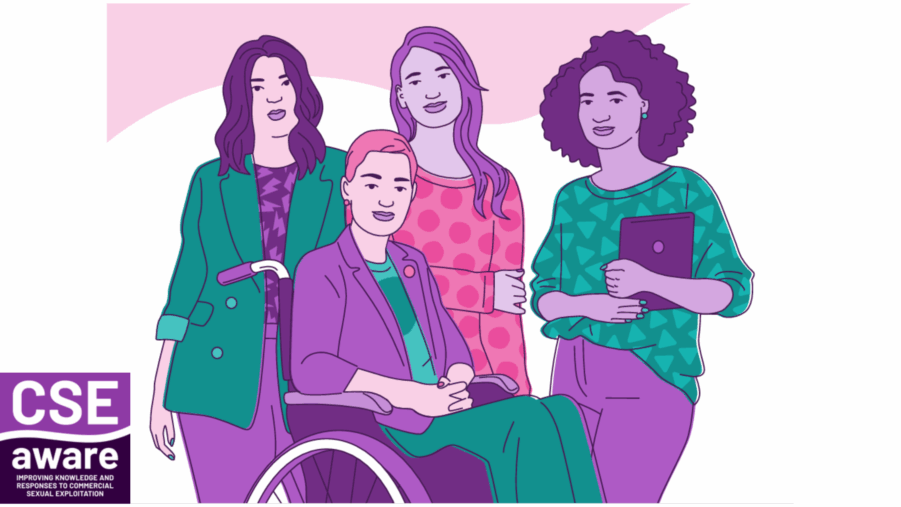
How can commercial sexual exploitation impact women with learning disabilities?
At CSE Aware we work to increase awareness of commercial sexual exploitation and support frontline staff to become more confident in responding to affected women.
Like any form of abuse, commercial sexual exploitation, or CSE for short, can happen to any woman. CSE is when a person (usually a man) offers another person (very often a woman) some form of payment in exchange for sex and/or sexual images. The payment can be money or things like drugs, alcohol, a place to live, groceries, and even affection.
CSE is one of the less considered forms of abuse, and very little is known about how it affects women with learning disabilities. Last year we set out to change this and started a small research project.
We did this work because we recognise that women with learning disabilities are often left behind in conversations around gender-based violence. Yet internationally it is known that they are at higher risk of abuse and exploitation. Frontline staff had also shared with us accounts of women involved in selling or exchanging sex who are diagnosed with, or are suspected to have, a learning disability.
We asked ourselves – what puts women with learning disabilities at risk of becoming involved in selling or exchanging sex? Are support services identifying that CSE is happening to women with learning disabilities? What supports do women need?
Over three months, we consulted frontline workers from different services – learning disabilities, housing, mental health, advice, violence against women. We found that abusive men target women with learning disabilities because of the disadvantage and exclusion women face.
Our research was an initial effort to capture women’s experiences. SCLD has also called on the Scottish Government to commission more in-depth research, and we firmly believe this is what must happen next. You can read the findings from our work here:
Creating accessible information about CSE
We are also excited to launch an easy read leaflet on CSE, aimed at both affected women and support organisations. We developed this after our research highlighted a lack of similar resources in Scotland and the UK.
The easy read is available in both written and audio formats and consists of five sections:
- What is CSE?
- What are the different types of CSE?
- How does CSE occur?
- What are the risks associated with CSE?
- How to get support.
Our leaflet emphasises that, regardless of the activities a woman may be involved in – such as street prostitution, escorting, lap dancing, or others – there can be various reasons behind it. It sends a clear message that women have the right to say no to sexual activity, even if they have been paid. We understand that it can be challenging for women to identify CSE and discuss it with others; however, there are support services that can help, and the easy read provides a list of them.
The guide was nine months in the making, and it would not exist without contributions by other organisations, including People First (Scotland), SCLD, and Central Advocacy Partners Survivors Project. Their feedback was invaluable in shaping the content, tone, and wording of the resource.
Brian Houston made another significant contribution by creating the illustrations and designing the overall leaflet. He thoroughly researched accessibility criteria and combined this knowledge with his creativity, resulting in unique images that convey a sense of warmth and welcome.
Whether you are a practitioner or an affected woman, we hope these resources help you to reflect on the dynamics of CSE and reassures you that those impacted by CSE are not alone. You can access the leaflet here:
